

Ray Gunn has lived in animation legend Brad Bird’s mind rent-free, predating that of his iconic features Iron Giant, The Incredibles, and the Australian breakdancer of the same name. His long-gestating passion project about a private detective operating in a retrofuturistic alien realm has finally been realized, and the result is a fun, mesmerizing film noir that acts as a love letter to classic cinema and a sophisticated gateway for families to introduce their kids to the genre that has been untapped in animation since Roger Rabbit. It really feels as if Brad Bird created his own Blade Runner for kids not old enough to watch Blade Runner.
In the retrofuturistic city of Metropia, where flying cars and AI-surveilled ads are plentiful, aliens are seen as second-class citizens in a human-prioritized society. While most humans are discriminatory, Raymond “Ray” Gunn (Sam Rockwell) isn’t. An ex-cop turned freelance P.I., Gunn struggles to keep his business afloat while operating in a grimy, corrupt underbelly. His insistence on always doing the right thing causes his finances to decline—he can’t pay his longtime cyclopsian, tripod-legged work partner, Eye-Ra Kadok (Tom Waits), and he’s fending off repos from taking his office’s possessions. All that luck turns when he’s hired by Arnold Dom (Bobby Cannavale), the fourth husband of Venus Nova (Scarlett Johansson)—a charming yet volatile Britney Spears-meets-Taylor-Swift-esque megastar songstress—to follow her when he suspects unfaithfulness. His better judgment on the assignment leads her label company, Megamax, CEO Barry (Alan Tudyk) to hire Ray as her bodyguard to keep the star out of trouble as they’re antsy over another public scandal amid her latest album release. As folks in Nova’s orbit are murdered, Gunn and Kadok are thrust into a vast web of mysteries involving alien crime bosses, finicky particle guns, an unsuspecting romance between a starlet and a detective, and a secret that could turn all of Metropia upside down.
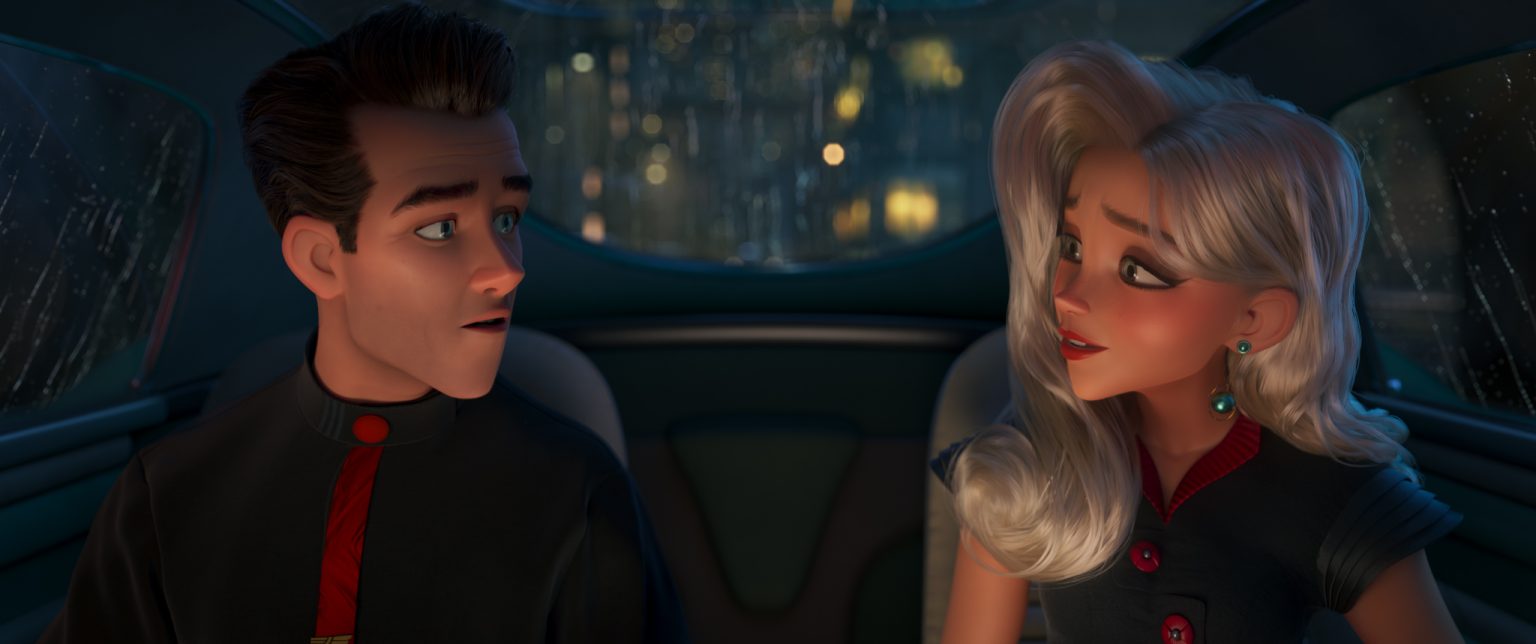
RAY GUNN – Raymond Gunn (Sam Rockwell) and Venus Nova (Scarlett Johansson). Cr: Skydance Animation ©2026
Ray Gunn is Brad Bird in his maximalist cinephile mode, wearing his love for Golden Age Hollywood noir flicks on his sleeve and demonstrating classic noir prowess with the same patience and visual style as the films he’s tributing. Much like his prior works, he immerses you in his classic-noir science-fiction realm, elaborating on Gunn’s lack of depth as his morally upright backbone contrasts with the gritty environment. Animation be damned, we haven’t had a traditional noir this lived-in in a very long time. The film naturally settles you into Metropia and the seedy underbelly long before Nova enters his orbit. When she does, the story engages with a satisfying, exciting mystery that even on a second viewing is fairly narratively tight. Bird uses his finest attributes (besides his retrofuturist love), carried from The Incredibles and even Mission: Impossible Ghost Protocol, to exercise the genre’s pastiche in exciting, imaginative set pieces bolstered by Michael Giacchino’s enchanting, swinging score. Each stealth scene in which Eye-Ra scales walls and buildings, capturing people caught in the act with his shutter eyes, is a prime example of the genre’s blend.
While staying true to its own world, each turn pays homage to a classic movie character or visual cue, much like Chazelle’s La La Land paid tribute to MGM musicals for a new audience. This film’s influences are more apparent in its characters’ personalities and wardrobes, which draw on The Maltese Falcon, Casablanca, Chinatown, and The Big Sleep. Gunn is essentially an amalgamation of every Humphrey Bogart character ever. Bird even does a Peter Lorre-like voice for a small-fish henchman and a slug-like mob-boss stand-in, Signor Ferrari (Sluggsy, Matt Berry). It functions as an effective introduction to the classics for families.
Skydance’s Best-Looking Feature Yet
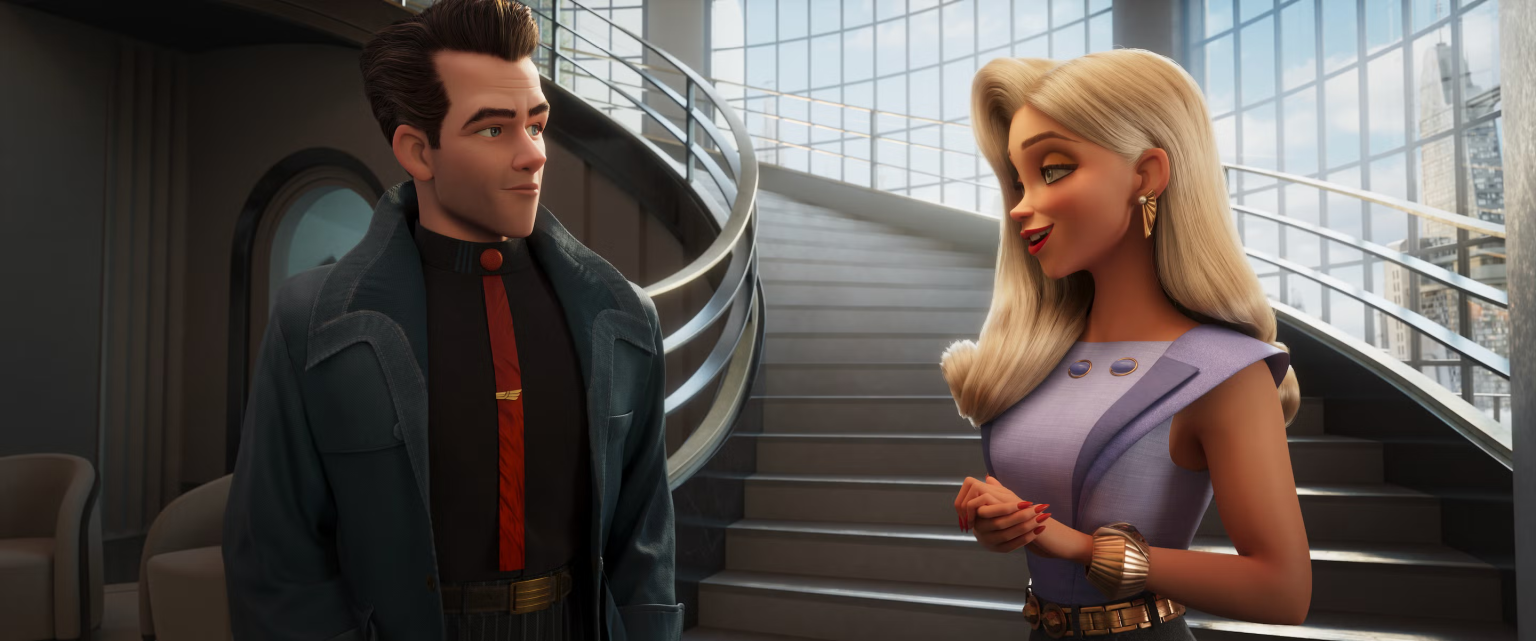
RAY GUNN – Raymond Gunn (Sam Rockwell) and Venus Nova (Scarlett Johansson). Cr: Skydance Animation ©2026
As Skydance Animation’s fourth production in a history of dull “we-have-Disney-at-home” features, this is the studio’s first creatively driven and visually stunning film to date. From the noir-aesthetic lighting cues to Bird’s art deco-obsessed architecture and interiors, the film pulsates with life as bright as the laser particles.
The lead character designers, longtime collaborators Tony Fucile and Teddy Newton, and Devonn Wilson, lay out a world as if The Iron Giant‘s geometric, curved humans coexisted among the exaggerated-shaped cells from Osmosis Jones, but were instead aliens. You can tell it is all hands on deck (if I were a director on any of their past projects, I’d be fuming considering how this is the one where they “locked in” because Brad Bird was the word), and it’s thoroughly mesmerizing. Every so often, you do wish it were as 2D-animated as he originally envisioned, especially in visible areas where corners were cut; the animation on incidental characters and crowd shots lacks polish, and the movement seems a bit stilted. It’s still a Skydance animation film after all.
Firing with the Safety On
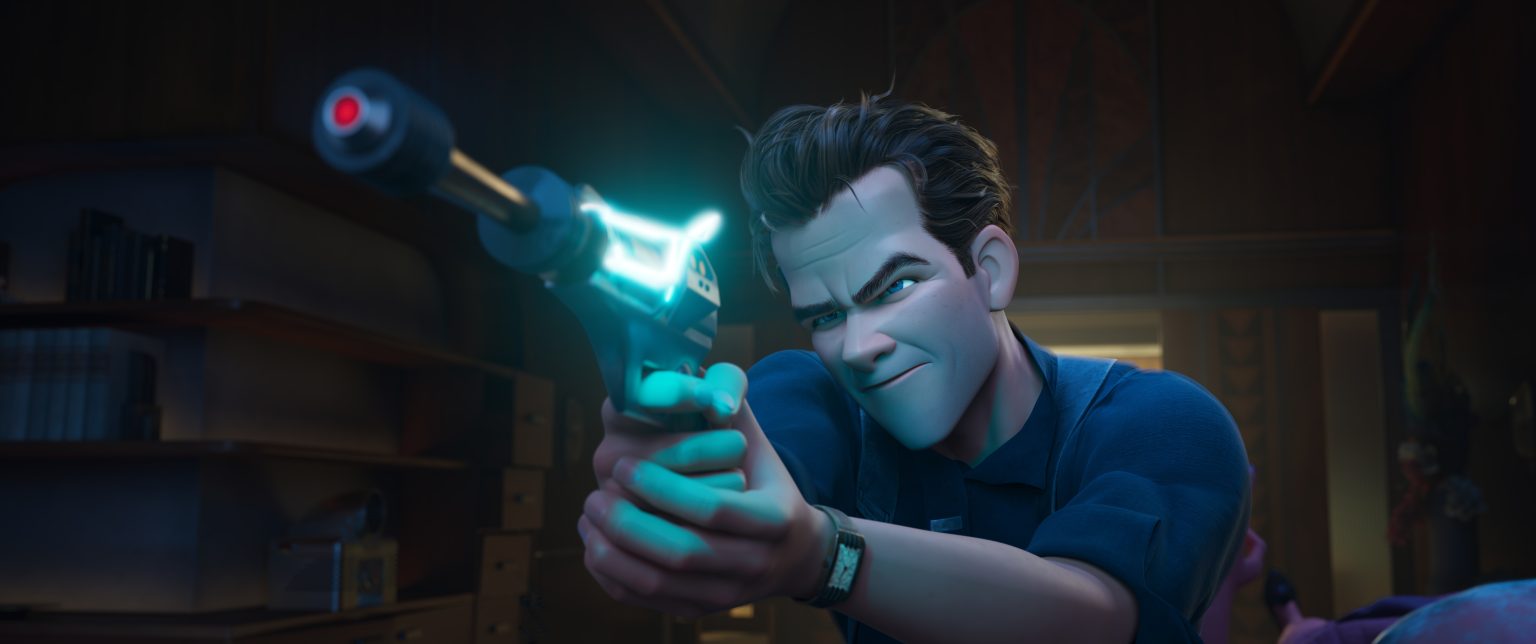
RAY GUNN – In Metropia, a gigantic city in an alternate future as seen from 1939, private eye Raymond Gunn is drawn into a case involving aliens, murder and a multimedia star named Venus Nova. Cr: Skydance Animation/Netflix © 2026
Ray Gunn‘s tonal maturity and edge are evident, but I would be remiss not to point out that it feels too constrained by its family-friendly appeal. It could have benefited from a more mature tone. Not that it is entirely kiddified, but Bird and Matthew Robbins’ screenplay feels more in the accessibility camp. Narratively, it’s tight but thematically clunky. The alien-human landscape is a parable of xenophobia, yet it’s underdeveloped, illustrating only Gunn’s tolerance toward others and window-dressing the aliens’ struggles to assimilate. It’s all foreshadowing a lesson on discrimination and equality that’s begging for development but never comes to fruition.
Bird and Robbins juggle too many variables, some skewering more contemporary ideas (anti-corporation, artist exploitation). Biting off more than they can chew, those themes feel clunky when threaded through the mystery. I was still screaming “coward” at the screen, because one reveal wasn’t pushed to the brink of its potential. As much as it seems to be Bird in prose and tone, you can’t help but feel the Ellison-tainted touch in the studio notes clipping the nuanced wings that would’ve made Ray Gunn’s blast a little more powerful. Of course, a Skydance-produced movie vocal about xenophobia wasn’t going to promote equality for marginalized communities. Instead, we get a simply entertaining throwback played so safe that it’s a far cry from his prior work—perhaps about the same quality as Incredibles 2.
Verdict
Ultimately, Ray Gunn is Brad Bird in his element, brimming with imagination and verve. But for all its dazzling craft and affectionate tribute to classic noir, it’s also a film constrained by the very machine that made it. Though the story doesn’t quite reach its full, mature potential, sanding Gunn down into safe, family‑friendly territory, it’s a worthy “baby’s first film noir” entry point. But Ray Gunn also leaves you wondering what could have been if Bird had been allowed to fire at full power.
Brad Bird’s Ray Gunn, a Netflix Original film, premieres globally on Netflix on December 18, 2026.