

Ludo Studio’s first live-action feature is a heartfelt, nostalgia-soaked spiritual successor to E.T., and its little alien is one of the most convincing creature creations Netflix has released in years.
Allen does somehow bizarrely carry the DNA of both of Ludo Studio’s biggest successes. There’s the care and attention lavished on a central character that’s made Bluey a worldwide sensation. But there’s also a central hook and a handful of horror-ish elements that recall Talk to Me, the word-of-mouth smash that creator, co-writer and co-director Daley Pearson helped get off the ground a few years back. Pearson shares directing duties here with Jeffrey Walker (Apple Cider Vinegar). The result is a film that shouldn’t really work on paper. As Pearson himself admits, it’s “a ridiculous proposition when you say it out loud.” And yet, for the most part, it does. It’s also another reminder that a studio that recruits locally and builds talent and infrastructure from the ground up out of pure passion can succeed, and Ludo should be an inspiration to filmmakers anywhere in the world, making world-class entertainment far from the monolithic and often archaic Hollywood machine.
Authentically Australian
Allen is unmistakably Australian, and it’s all the better for it. Shot along the southeast Queensland coast, with Pearson’s own hometown of Coolum at its heart, the film is packed with beautiful scenery, from sun-drenched beaches to quiet coves beneath Mount Coolum. The 1998 sequences are a particular treat for anyone who grew up in that era. Pearson’s brief to his production team was to “put things in the film that people have forgotten they remember,” and they deliver, with Cheezels, Tazos, Bubble O’ Bills, Street Sharks and Etch A Sketches all making an appearance. Director of photography Toby Oliver gives it all a warm, slightly dreamy look, shooting on anamorphic lenses with a grade that mimics ’90s Kodak film stock. The flashback section at the beginning genuinely glows.
Allen is frequently witty and almost always charming. Pearson has said his two favourite films are Dumb and Dumber and Stand by Me, and that Allen “lives somewhere between those two.” That’s a fair description, and it explains why the film never quite settles into being a straightforward comedy or a straightforward coming-of-age story. The laughs don’t land every time but at its core, this is a film about loss, grief and not being able to let go of childhood. It’s never too heavy-handed with that message, though, with Petey and Allen’s relationship always at the heart of the story and more good times than bad.
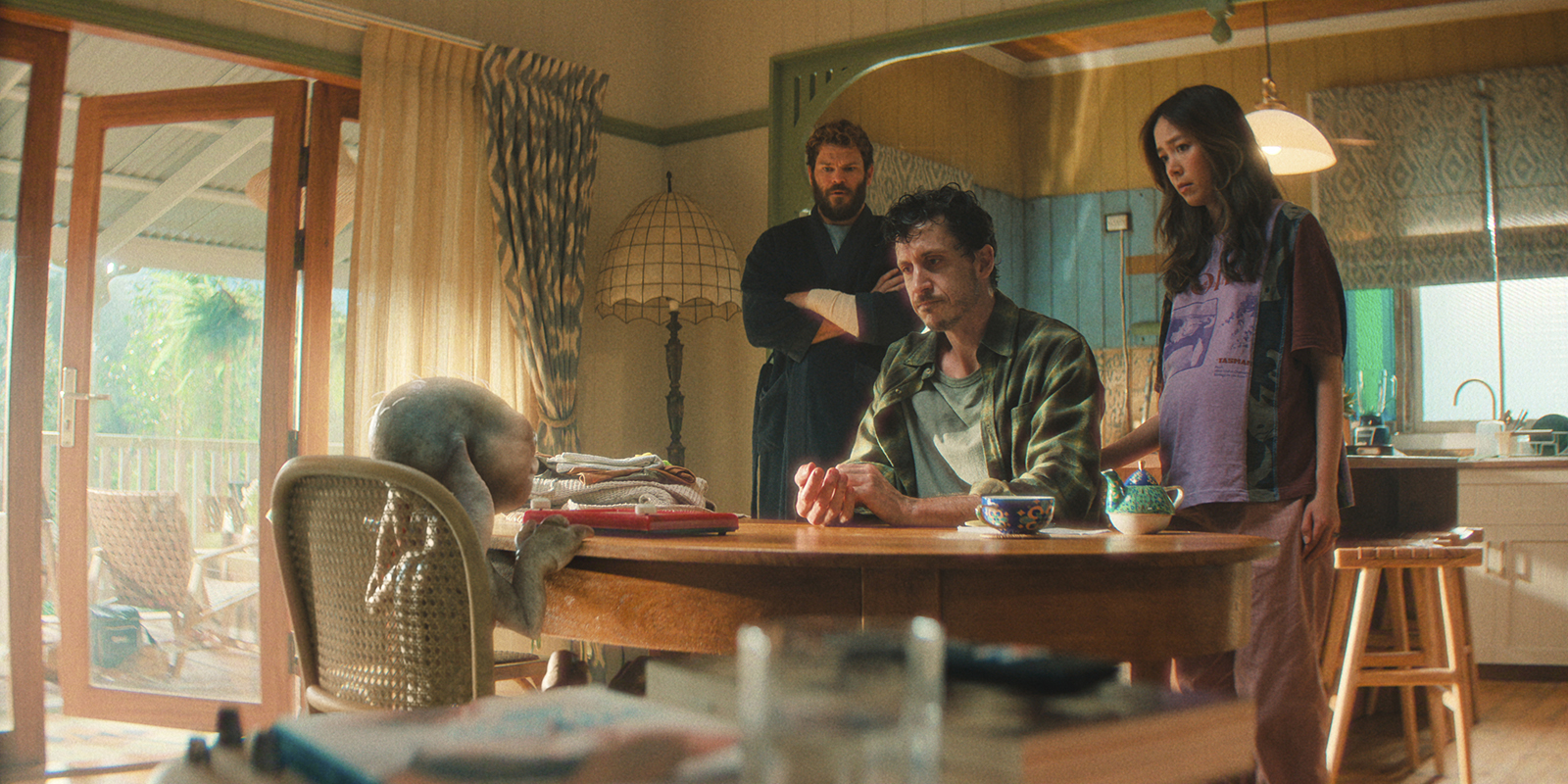
Allen. Josh Helman, TJ Power, Charlotte Nicdao and Allen in Allen. Cr. Netflix © 2026.
The VFX is the star
The real star, though, is Allen himself. The team behind him went through multiple evolutions to bring him to life. A fully animatronic version was abandoned, and the end product is part physical puppet, built by Formation Effects, and part animation and visual effects from Alt.VFX. Doing both seems like a costly endeavour, but in truth, it works to the movie’s advantage. TJ Power’s performance as adult Petey, and that of Edward O’Sullivan as young Petey, is infinitely more authentic because of how much they interact with Allen. You can tell they’re acting opposite something real and tangible. Normally, subtle off-glances and dry line readings give away that an actor is talking to a green ball on the end of a stick. That never happens here. It also helps that the film isn’t afraid to put Allen front and centre in broad daylight rather than hiding him in the shadows or keeping the action strictly at night. Combine that with an Allen who seems to evolve, showing a wider range of emotions the more time he spends with us humans, and he really grows on you.
Power is well supported, too. Charlotte Nicdao, fresh off Mythic Quest, and Josh Helman are particularly good as the grown-up Carly and Jaden, the long-suffering couple trying to nudge Petey towards adulthood with them keeping the story grounded to reality.
Without getting deep into spoilers, the reference to Predator fairly early in the film turns out to be a bit of a misdirect. By the second half, Allen leans much more towards its counterpart, Alien, thanks to a particularly funny Etch A Sketch reveal that sets up the central twist and the moral conundrum that drives the rest of the film. It’s a neat nod to the joke that started it all. Pearson says the original idea came from wondering what would happen if someone spent their whole life missing E.T., “only to finally reunite with him and discover he’d grown into a Xenomorph.” Allen’s mission itself is left a little nebulous. Who sent him, and why he’s really come back, are never fully spelled out. You can make a few assumptions here, particluarly on why he cam back, but that’s ultimately beside the point. The friendship between Petey and Allen is what matters, and the rest becomes detail that’s left to your imagination and while the ending does seem to leave things wrapped up nicely, the door is left ajar for more if the audience is there.
Verdict
Allen has real cross-generational appeal. It’s unashamedly nostalgic, touching on what Stranger Things did so well for the ’80s. Kids will come for the alien, and parents will find the heart sneaks up on them. Is Allen the next E.T. or a spiritual successor of some description? Almost certainly the latter, but given how rarely family films attempt something this personal, heartfelt and handmade, that’s no small compliment. It’s a film about holding on to the wonder of childhood without letting it stop you from living, and it deserves to find an audience far beyond Queensland.
Allen is now streaming on Netflix globally.