

As TV producers prepare a Fox reboot of the 1990s lifeguard drama Baywatch, they’d be wise to study the mistakes of their predecessors. A few of those hard-learned lessons: Protect the female cast members. Give them serious storylines and not just skimpy swimsuits. Showcase a diversity of humanity. And don’t piss off the locals.
(Judging from the teaser trailer for the new production, it looks like we’re just getting more slow-motion shots of skinny blond women in low-cut one-pieces.)
The original Baywatch, which aired from 1989 to 2001 on NBC and syndication, had problem after problem, as you’ll see below. We’d consider the issues below the biggest controversies from that Baywatch iteration, and we’d say producers could have averted all but one of them.
6. Australia’s backlash to the production
Locals in Avalon Beach, Australia, revolted after Baywatch filmed episodes there in 1998 and considered moving there full-time. Around 1,700 Avalon Beach residents showed up at a public meeting to oppose the move, complaining about the Baywatch closing down part of their beach and threatening the area’s koala population and producers demanding that locals stay quiet during filming, according to BBC News.
Baywatch producer Greg Bonnan offered a testy rebuttal, saying, “We’re not going to go where we’re not wanted. It’s a matter of who wants us to spend a couple of hundred million dollars in six years, and who wants to export to the world the most important television program.”
5. Jeremy Jackson’s swimsuit-sniffing confessions
Social media users were appalled by what Baywatch star Jeremy Jackson (Hobie Buchannon, pictured at far right) said in the 2024 docuseries After Baywatch: Moment in the Sun. In that doc, the actor admitted to secretly sniffing his female costars’ swimsuits. “There was all these hot chicks, and I would usually sneak in their trailers after they were done and grab their dirty bathing suits. Let’s just say I’ve smelled every p**** on Baywatch,” Jackson said, per Entertainment Weekly. “Nicole [Eggert, who played Summer Quinn, pictured next to Hobie] was the big one, for sure. We had a very intimate moment, her and I, that she never knew about.”
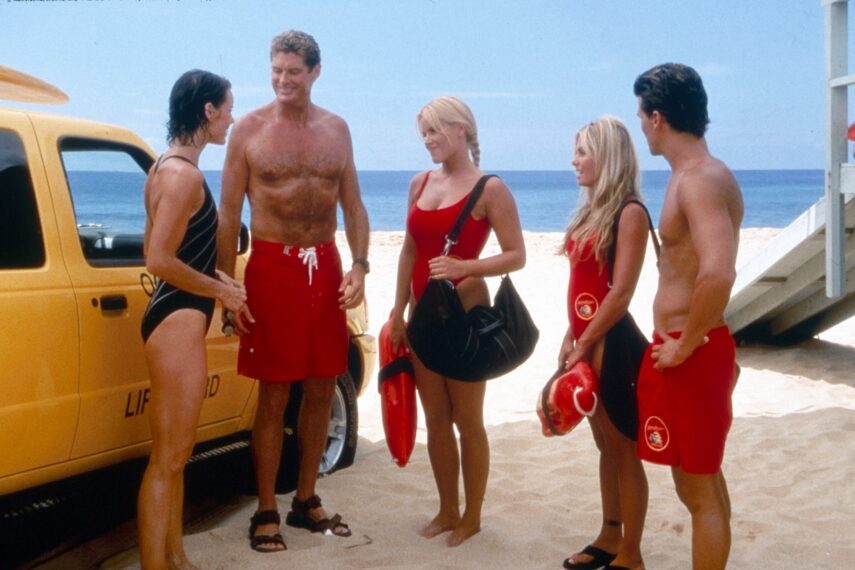
Everett Collection
“That’s disgusting,” one X user wrote. Another said, “What a creep! What did you think admitting you did this would accomplish?”
Jackson previously told Howard Stern he also pleasured himself while smelling a swimsuit worn by Pamela Anderson (C.J. Parker).
4. Body-negative conditions on set
Baywatch cast members also had to conform to certain physique standards. In After Baywatch, Eggert explained that the actors were prohibited from gaining or losing five pounds, per OK!
Angelica Bridges (Taylor Walsh) added, “We had to stay fit, we couldn’t get cellulite. There was a lot of pressure.”
And it wasn’t just the female cast members who felt the pressure. Jackson said his mother hired a trainer for him after producers “prodded” him about his “skinny arms and chubby belly.”
3. Pamela Anderson’s relationship — and sex tape — with Tommy Lee
If Anderson’s Baywatch role didn’t make her a tabloid target, her relationship with Mötley Crüe drummer Tommy Lee certainly did. In the middle of her run on the show, the actor suffered a public humiliation when a private sex tape she made with Lee, her then-husband, was stolen and distributed. In After Baywatch (per The U.S. Sun), Baywatch co-creator Michael Berk said the studio considered suspending Anderson from Baywatch amid the scandal, though the show ended up getting “like, twice the ratings.”

Frederick M. Brown/Getty Images
Lee also became enraged about Anderson’s love scenes on the show. “I had to kiss David Chokachi [Cody Madison], but I didn’t tell Tommy,” she wrote in her journal, according to The Guardian. “He lost it. He trashed my trailer on the set, put his fist through a cabinet. I apologized for not telling him — lying, as he put it — and told him it wouldn’t happen again.”
On another occasion, Lee rammed his car into Baywatch’s makeup trailer, Anderson recalled.
2. Baywatch’s white bias and lack of diversity
In After Baywatch, Gregory Alan Williams (Garner Ellerbee) described his experiences as one of Baywatch’s only actors of color. He recalled, for example, being turned away from a Season 1 promotional photo shoot, at which a producer said Williams wasn’t needed.
“I realized that I was not what they were selling,” the actor said, per Entertainment Weekly. “Baywatch was a show that celebrated European beauty, So, at that point, I put up a wall between myself and the show and decided I would have the fun and make the money, but I wasn’t going to let it hurt me. Those were Baywatch lessons.”
In the same doc, Alexandra Paul (Stephanie Holden) remembered her character getting a Latino boyfriend only after she begged producers for a love interest of color. “And then I read the script, and he’s a gang member,” she said. “And I went back to the producers, and I said, ‘You cannot make him a gang member.’ So they made him an ex-gang member.”
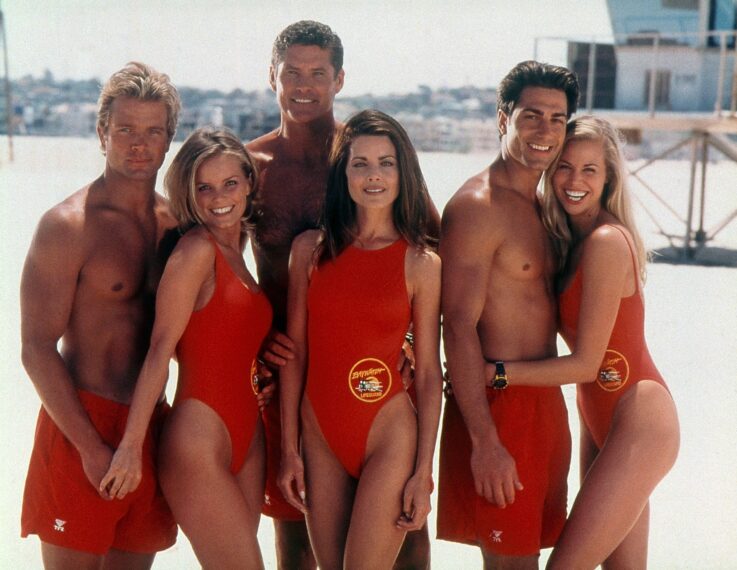
Pearson All-American Television/Courtesy: Everett Collection
1. The show’s objectification of its members
Arguably, the most prevalent criticism of Baywatch is its treatment of its female stars, whose storylines were often more sexualized than substantive.
In a 2024 essay for MSNBC (now MS Now), Jill Filipovic argued that Baywatch reflected the cultural expectation that famous women be sexually performative for men. “As the show went on, the legs of the red Baywatch suits got higher-cut, and the necklines dropped lower…” Filipovic wrote. “Sometimes, there just wasn’t enough actual footage to fill the show’s full run-time, and so it was padded with montages of California sunsets, perky butts on beaches, and of course, the notorious slo-mo breast-bouncing runs down the sand.”
Metro’s Brooke Ivey Johnson called out the show’s “overt misogyny” in an essay that same year, writing, “Known for long close-up slow-mo shots of cast members jogging towards the shoreline, Baywatch became synonymous with ogling hot women in skimpy swimwear and little else. To be more specific, it became synonymous with ogling thin, white women.”