

The Pitt, with its real-time aspect, doesn’t give viewers too much about each character, at least not at once. Instead, we get moments here and there where we learn a fun fact — like Langdon being a big fan of historical reenactments, which was a surprise for the actor who portrays him, Patrick Ball, who has been nominated for an Emmy for Outstanding Supporting Actor in a Drama Series for his exceptional work in Season 2.
“It’s a really fun way to build a character because you just get little nuggets here and there, and over time, these things add up to a complete and multidimensional person, which is really cool,” he explains to TV Insider in the video interview above. “It’d be really easy to come in and play the archetype of edgy addict, doctor, hothead sort of guy. But this guy can also be a complete dork and can also be really hyperactive and nerdy and can also be sad and can also be angry and can be all of these things, and you build out their personality just glimpse by glimpse.”
When we first met Langdon in Season 1, the guy couldn’t be more confident — in his work or where he stood with his boss, Robby (Noah Wyle). That all changed once it was revealed that he was an addict, and he came back from rehab for his first shift in 10 months in a very different place when Season 2 began. Suddenly, he was a fish out of water in a familiar setting, with two especially tough conversations ahead of him: with Robby, who didn’t want him back in his ED, and with Santos (Isa Briones), who had been the one to pick up on what was going on with him in Season 1. Ball brilliantly played the layers of those conversations (and the turns they took) as well as his attempt to find his footing at work, first relegated to triage then eventually back in the trauma rooms, even doing a closed reduction, showing just why he rightfully earned that Emmy nom.
“I was really excited about the opportunity that 10 months away would present because you meet somebody in Season 1 that, like you said, is very confident and you think you know who this person is, and then about halfway through season one, you realize that this facade that you’ve met in Langdon is being propped up by drugs and may not be as truthful as you may have assumed,” Ball says. “What happens when you decontextualize that person from this space, and especially somebody that struggles with addiction? People that struggle with addiction can really struggle with having a core sense of self. And so I think he is probably a water sign that adapts to whatever shape the container is around him. And so he has adapted to this space and you get to see him not having been shaped by this space for a while.”
Warrick Page/HBO Max
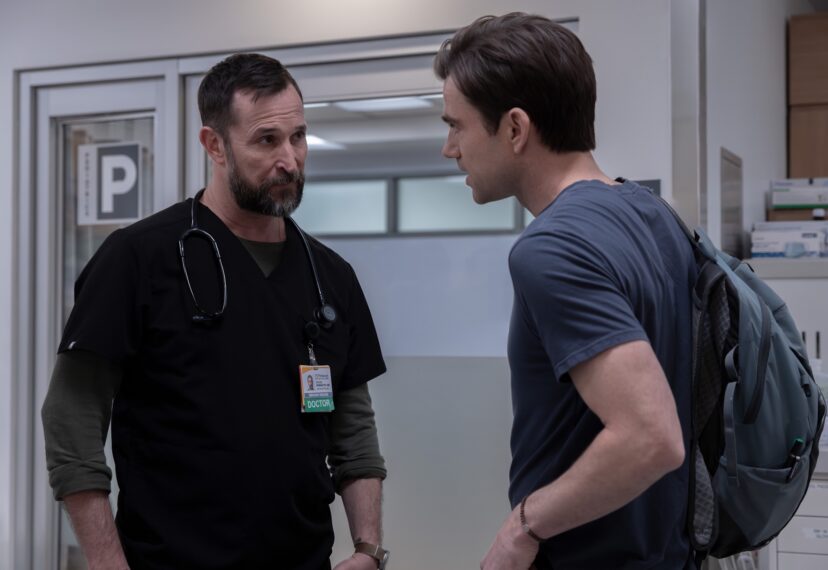
By the time Langdon and Robby talk, the shift is long over, and the latter even thinks the former has left. That encounter shifts to Langdon calling Robby out on being the one who needs help, something that everyone (in the ED and viewers) watched all season.
“I think he comes in the door right at the beginning knowing that he has to make amends and knowing that some bridges need to be built and that he has a lot to apologize for, and I think he comes in with the hope of doing that and taking ownership over his part and so that they can reestablish this relationship and move on,” explains Ball. But because it took all shift to get there, he saw that his boss was not OK. ”
He continues, “I think when you have a mentor figure, whenever you’re a kid growing up with your parents, you don’t really see your parents as people with their own problems and their own things that they need to work through. They are just dad and mom, and they’re just there to facilitate your growth process. And I think maybe unconsciously that is the box that Langdon put Robby in of, ‘Robby is here to be my mentor and to be my friend.’ And I think it took the shift for him to come back in and realize, ‘Oh wait, no, this is a whole person that is not just an accessory to my healing, but is struggling himself. And I can actually be of use to him,’ which I think is not something he came in the door aware of or ready to do at the beginning of the shift.”
With Santos in Episode 11, however, while he apologizes, Langdon focuses more on himself, whereas she’s looking at the bigger picture, at the consequences he didn’t face and the possibility of him relapsing. These are two very strong personalities who may just be too similar not to clash.
“I think the feelings with Santos are obviously probably a lot more complicated [than with Robby]. As right as she was, and I do think at the end of the day, Santos may have saved Langdon’s life by doing what she did, but that is hard to see it that way whenever [his] entire life plan got really derailed,” says Ball. “I think the better half of Langdon is sitting there trying to own his part in things, and the other half of him is being like, ‘Man, you ruined my freaking life.’ … [R. Scott Gemmill and John Wells are] right in understanding that a relationship like that is not going to be righted in one shift in one day. That’s a lot to overcome.”
Watch the full video interview for much more from Patrick Ball on Langdon’s The Pitt Season 2 journey and what’s to come in Season 3.
The Pitt, Season 3, 2027, HBO Max